

Lipinsky, Sigmund
Available Artworks
Sold Artworks
Biography
Sigmund Lipinsky
1873 Graudenz (West Prussia) – 1940 Rome
Sigmund Lipinsky trained at the Berlin Academy of Fine Arts from 1892 to 1896. He was initially taught by the celebrated animal painter Paul Meyerheim and later by Anton von Werner, one of the leading history painters active in the German Reich. In his role as Academy President Meyerheim enjoyed considerable influence over artistic events in Prussia. He was widely recognised for his well-grounded teaching methods. From an early age Lipinsky was determined to reach the highest level of technical perfection and could have found no better teacher than Werner.
After completing his training Lipinsky caused a stir with a monumental painting executed for the Moltke family castle titled French Troops Entering the City of Lübeck in 1806. The painting owed much to the style of history painting practised by his teacher Werner and was awarded the Großer Staatspreis. It earned Lipinsky a three-year scholarship to Rome, fulfilling his long-held dream to experience the art and spirit of antiquity. He settled in Rome in 1902 and remained there until his death, only breaking his stay during the First World War. Early in his stay he took a studio near Piazza del Popolo, located in the enchanted, idyllic gardens of the Villa Strohl-Fern. Here he was to produce a number of ambitious paintings on mythological themes, no doubt prompted by the need to fulfil the demands of the scholarship. Paintings such as Circe and In the Garden of the Hesperides are executed in a subdued palette associated more with drawing techniques than with painting. A few years later Lipinsky was to largely abandon painting in favour of printmaking and drawing, with the exception of occasional studies.
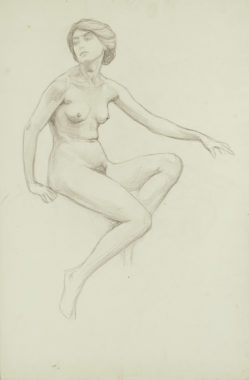
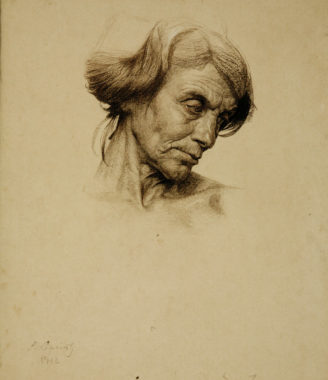
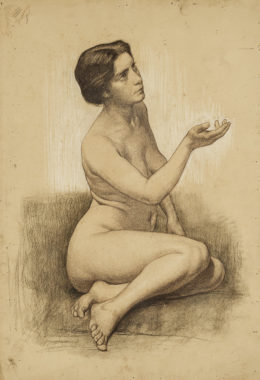
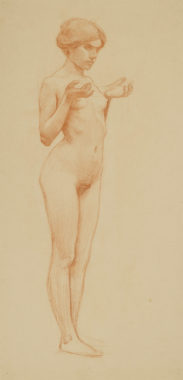
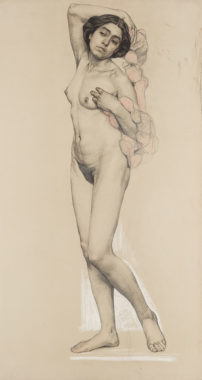
Lipinsky gradually distanced himself from the early artistic influences of his training. He began to undertake extensive excursions, exploring the city’s churches, museums and monuments and capturing them in detail in his drawings. Over the years, this was to produce a wealth of knowledge and large pool of motifs which he drew on time and again. This remarkable body of material was enriched and supplemented by his study of the Mediterranean landscapes between Rome and the Gulf of Naples, where he spent the summer months. However, his primary focus was on drawing from life and his preferred subject, the female nude.
After a time Lipinsky gave up his studio in the gardens of the Villa Strohl-Fern and moved to a series of different studios on Via Margutta, near the Spanish Steps below the Pincio. Here, he could live and work at the epicentre of the German community of artists in Rome. He gained considerable recognition for his support of the Deutscher Künstlerverein and for his work as a teacher, running his own school of drawing and painting.
Drawing on a lifetime’s wealth of observations and studies gathered in Rome, Lipinsky created an extremely rich body of work, both in scope and content. It comprises prints, drawings and paintings. With his preference for motifs and subjects from antiquity he shared the tradition of an earlier generation of German artists and writers working in Rome, such as Arnold Böcklin, Anselm Feuerbach and Hans von Marées. Following their example, Lipinsky pursued the quest for a symbiosis between classical form and monumental composition based on harmony. His works carry a hint of melancholy. It is no surprise that he mingled with other German-speaking artists of his generation in Rome, for example Max Klinger, Otto Greiner and Adolph Hirémy-Hirschl. However, Lipinsky’s true objective was to glorify human beauty in the spirit of antiquity, an essential facet of the original artistic ideal pursued by his German precursors in Rome.
PDF Download